
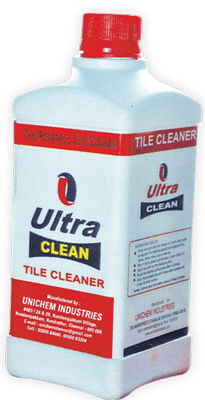
Ultra Clean
ULTRA CLEAN is used for cleaning interior or exterior surfaces (including façades) of staining caused by cement, lime, efflorescence including dirt and oil.
Instructions for use
- Dilute one part ultra tile cleaner to 4 parts of clean water as required for cleaning Glazed and Unglazed Tiles, Bricks, Slates Stone, Quarry Tiles etc.
- Wear a hand gloves and dampen a clean cloth in it.
- Apply the cloth on the desired surface
- Brush the applied surface area after 5 minutes
- Clean the brushed area with clean water properly for a neat & shiny surface
Application
- Cleaning cement and lime stains from the surfaces of ceramic tiles and mosaics on walls and floors.
- Cleaning off residues of cement-based products used as adhesives or for grouting ceramic surfaces.
- Cleaning efflorescence of lime, salt pert etc. on ceramic surfaces or joints between tiles, concrete, plaster etc.
- Cleaning dirt that has accumulated on the construction site on building materials, such as ceramic tiles, sinks and tanks, anodized aluminum, stainless steel, chromework etc.
- Cleaning off slight rust stains
As a liquid in a 15% water solution for easier handling in ordinary cases. ULTRA CLEAN is based on a special organic acid with the advantage that it is as aggressive to stains and efflorescence as much stronger acids (muriatic, hydrochloric, sulphuric etc.) but, unlike these, does not produce highly dangerous toxic fumes. Correctly used, ULTRA CLEAN does not damage joints between ceramic tiles, even those grouted with colored products; but on the contrary, it removes efflorescence that sometimes form on their surfaces.
Never use ULTRA CLEAN on marble and in general on other calcareous stone or on reconstructed derivatives. Do not use ULTRA CLEAN on ceramic tiles or surfaces where the glaze is not acid-resistant. When working with ULTRA CLEAN, wear rubber gloves and goggles, and avoid splashing the product on the skin and clothes. Before use, make sure that the surfaces that need cleaning are acid resistant. In doubtful cases it is recommended to carry out preliminary tests. The contact between ULTRA CLEAN and metallic surfaces may cause corrosion. Do not leave ULTRA CLEAN on the joints too long and wash with plenty of water to remove any product residue which could provoke color variation. Prevent ULTRA CLEAN from coming into contact with metallic surfaces or finishes as this may result in corrosion.